Pilot 3:
Cross-border development of sustainable and slow tourism

The aim of the pilot activity is to develop a model on cross-border development of sustainable and slow tourism and provide benefit for 27 Italian and 13 Slovenian municipalities in a cross-border area of Slovenia-Italy to improve cross-border sustainable tourism.

Introduction of the pilot

How can cross-border cooperation create a more sustainable and locally rooted tourism destination?

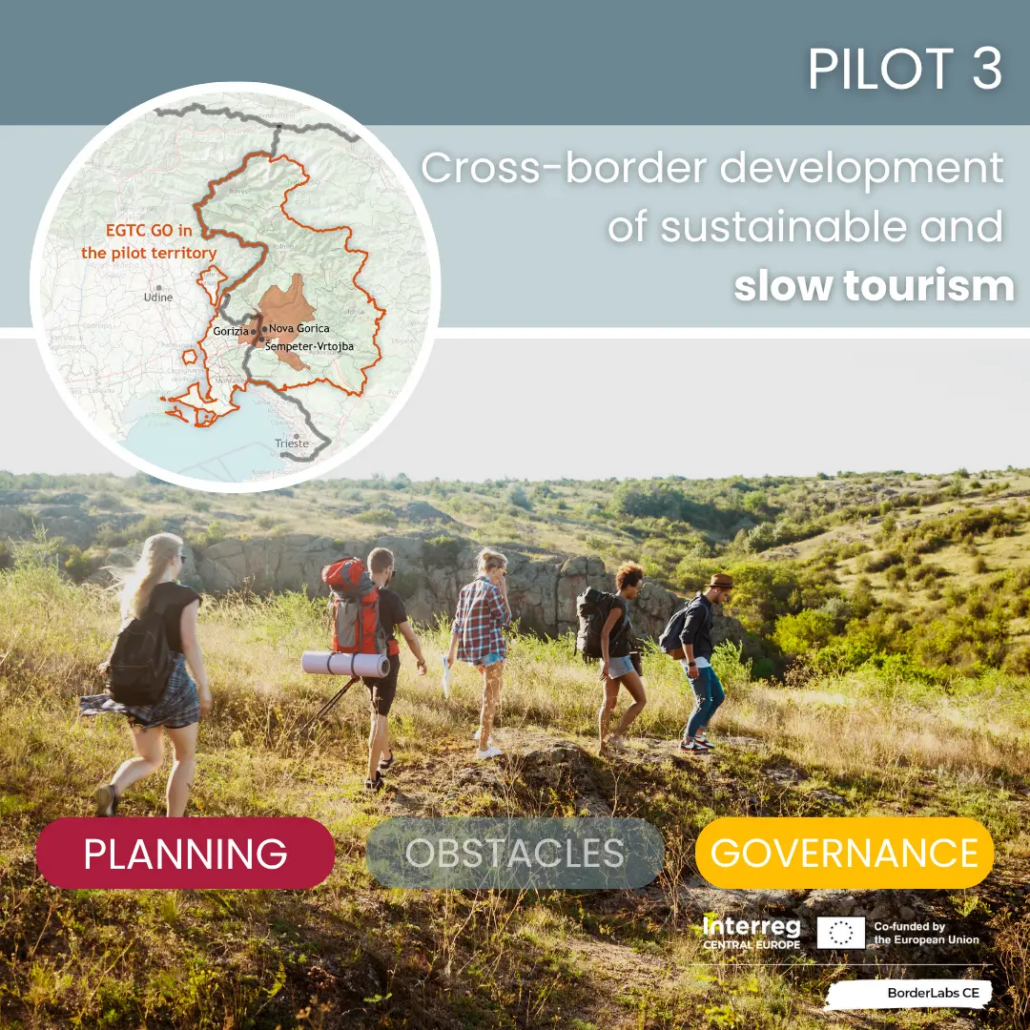
The pilot explored how the territory of the EGTC GO — comprising the municipalities of Gorizia (Italy), Nova Gorica and Šempeter-Vrtojba (Slovenia) — can develop into a sustainable and slow tourism destination, with a particular focus on cycle mobility and sustainable accommodation.

A key feature of the pilot was its participatory approach. Local and regional stakeholders were actively involved in identifying challenges, priorities and opportunities, and in developing and consolidating a cross-border model for sustainable and slow tourism. This ensures that the model is not developed as a stand-alone concept, but reflects the knowledge, needs and perspectives of the actors shaping tourism and mobility in the area.

By combining an analysis of existing frameworks and initiatives with stakeholder consultations, a cycle tourism survey and cycling data collected through bike counters, the pilot provides a practical evidence base for identifying weaknesses, priorities and opportunities for future action.

Pilot area

The area of the pilot is formed by a conurbation of three cities: Gorizia in Italy, Nova Gorica and Sempeter Vrtojba in Slovenia. The three cities are located close to each other and interconnected and placed together at the crossroad of different valleys and geological specific areas, as the Soča Valley, Vipava Valley and Karst, Goriška Brda and the Northern Adriatic Sea. At the same time the whole area on the border between Italy and Slovenia is rich in natural sights: from the sea to the mountains, from lakes to rivers and also waterfalls and caves.

Intervention logic, objectives and activities

General objective: To develop the conditions for cross-border sustainable tourism in the border area.

Specific objective: To develop green and slow tourism in order to improve the conditions for sustainable tourism, based on bike mobility.

In the year 2025, Nova Gorica (SL) and Gorizia (I) will be the European Capital of Culture – ECoC GO! 2025. The EGTC GO’s goal is to exploit the visibility that the nomination to the European Capital of Culture brings, providing a long-term benefit to the area, and developing a type of tourism based on sustainability.

Being the ECoC is a great opportunity, but at the same time, it also leads to several issues and challenges, as the cross-border urban mobility planning, the lack of enough accommodation for the upcoming flows of tourists in the area (during, and in the effect of the ECoC), the joint organisation of cultural events, the language gap, and the creation of cross-border networks between tourism and recreational operators in the area.

Moreover, as widely acknowledged, tourism has a major environmental and social impact. For this purpose, EGTC GO will implement the pilot action on cross-border development of sustainable and slow tourism that will focus on two main areas of intervention: Bike mobility as a way to move around the urban and the peri urban area, connecting the cities to different cultural and natural sights, and sustainable ways of accommodation.

As part of the pilot activity, EGTC GO will develop a draft model for cross-border development of sustainable and slow tourism, which will be evaluated and consolidated in a participatory stakeholder process, involving local and regional institutions as well as stakeholders and touristic operators. At the same time the model will be developed based on the effective data collected with the installation of movable bike counters, to be placed in various strategical spots of the cities: on the main streets of the cities and on the newly created cycling path, in order to define the number of cyclists in the peri-urban and urban area, assisting city planning and supporting the definition of ways to further improve bike mobility in the area.

The pilot should help understand the best ways to keep the important effects the title brings to the territory also in the years after the 2025, turning the two cities and the whole border area into a destination for sustainable tourism.

Relevance of the pilot

This section will be updated following the release of the final pilot report.

The solution

This section will be updated following the release of the final pilot report.