Pilot 1:
Integrated cross-border strategy development

The aim of the pilot activity is to develop and to implement a joint governance model for integrated cross-border strategy development in the Three- Country Area between Germany, Poland and the Czech Republic.

Introduction of the pilot

How can citizens become a more permanent part of cross-border governance? 

The pilot was implemented in Frankfurt (Oder) and Słubice, two cities on the German-Polish border with a long history of cross-border cooperation. Every day, people live, study, work and use services across the border. Yet opportunities for citizens to participate in shaping their shared future remain largely organised within separate national and municipal systems.

The pilot tested a citizen-oriented approach to cross-border governance, bringing residents and local stakeholders into structured dialogue about the challenges, differences and opportunities they experience in everyday cross-border life. Rather than creating new cooperation structures from scratch, it explored how existing institutional cooperation could become more participatory, stable and meaningful for citizens.

At the heart of the pilot is the Cross-Border Citizen Dialogue and Citizen Council Model – a practical approach that connects recurring citizen dialogue, citizen representation and a structured mechanism for bringing recommendations into political and administrative decision-making.

Pilot area

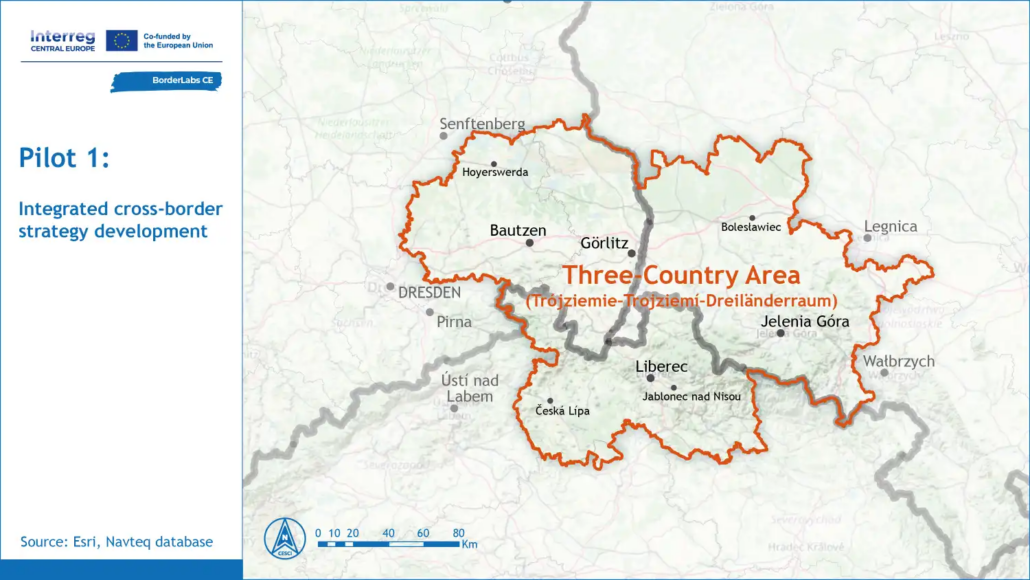
The target area is located in the trilateral interaction area between Germany, Poland and the Czech Republic. The geographic confines are defined by the administrative borders of the German and Polish districts and the Czech regions and subregions.

The German-Polish border is situated along the river Lusatian Neisse. The German-Czech border is situated in peripheral and rural areas, and partly along mountain ranges (Lusatian mountains). The Polish-Czech border is situated in the Turów area (strongly influenced by Turów coal mine), in peripheral and rural areas and along mountain ranges (Jizera mountains, Giant mountains).

Intervention logic, objectives and activities

General objective: To contribute to better knowledge and enhanced capacity for participatory cross-border cooperation governance in central Europe through coordinated approaches and co-learning processes in the fields of integrated planning and participatory governance in the Three-Country Area, supporting the realisation of joint development and transition processes towards more sustainable (and future-oriented) sectors of the economy

Specific objectives:

  1. To support the joint understanding of mutual benefits of day-to-day interactions in the Three-Country Area
  2. To support the joint understanding of territorial (cross-border) potentials in the Three-Country Area
  3. To support the development of trilateral cooperation approaches in the Three-Country Area through the provision of a joint strategy framework

The rationale and motivation of the pilot action is to develop a jointly agreed governance model for integrated cross-border strategy development in the Three-Country Area between Germany, Poland and the Czech Republic. The pilot area is characterised by a long record of bilateral and trilateral cooperation in the framework of the Euroregion Neisse-Nisa-Nysa, and cross-border cooperation is supported through three bilateral Interreg A programmes (PL-SN, PL-CZ, SN-CZ). Whereas in theory Interreg A projects are open for trilateral cooperation due to flexibility rules, in practice trilateral cooperation is not supported through Interreg A funds yet.

The pilot area is challenged through the need for decarbonisation of the regional economy, which in the German and Polish part of the Three-Country Area is shaped to a large degree through coal industry. Additionally, the Turów coal mine in the heart of the Three-Country Area influences cross-border relations, causing tensions e.g. due to its effects on the local environment. In long-term perspective, in the German and Polish parts of the Three-Country Area transition processes towards more sustainable (and future-oriented) sectors of the economy are needed.

Huge challenges in this area include: demographic changes, especially the aging of society, loss of socio-economic functions of cities, energy transformation and restructuring of the lignite industry, shaping the future labour market and education, preserving multicultural heritage and restoring biodiversity. All these issues require coordination of the territorial development policy and spatial policy.

The jointly agreed governance model for integrated cross-border strategy development shall enable the local and regional stakeholders to realise these transition processes for the mutual benefit of all partners, facilitating at the same time the mutual understanding of German, Polish and Czech stakeholders. To support this aim, in the result of the pilot action a citizen-oriented vision for future trilateral development and successful transition shall be elaborated, laying the ground for follow-up activities.

Relevance of the pilot

This section will be updated following the release of the final pilot report.

The solution

This section will be updated following the release of the final pilot report.