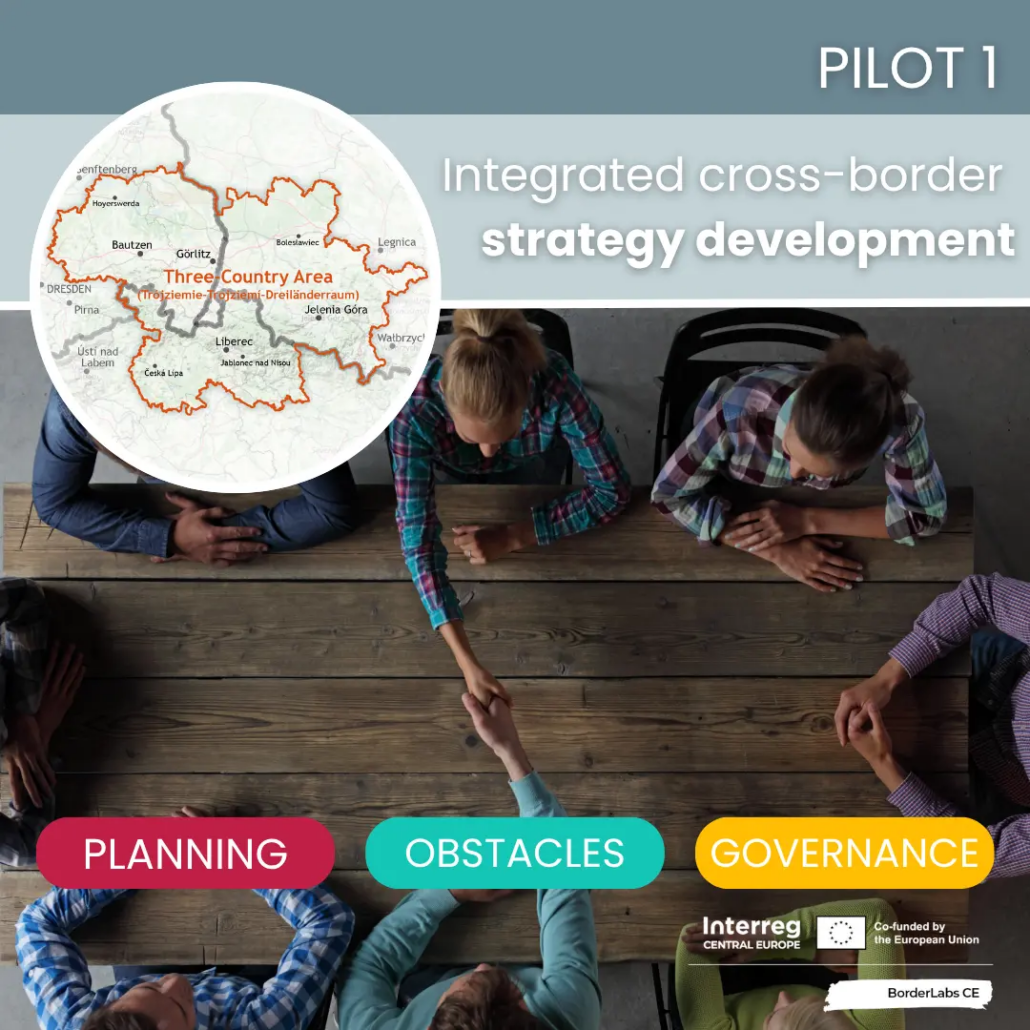
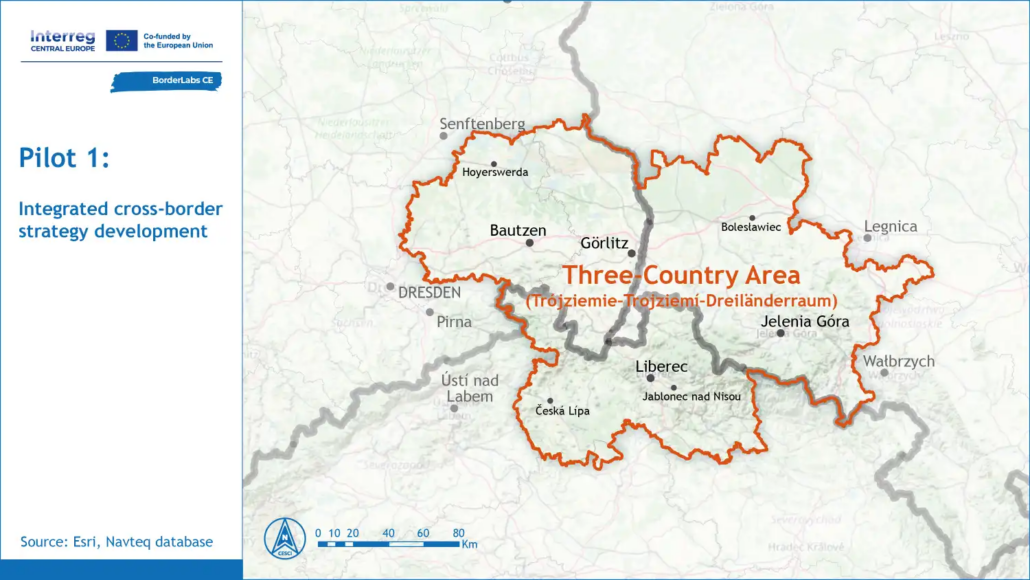
The rationale and motivation of the pilot action is to develop a jointly agreed governance model for integrated cross-border strategy development in the Three-Country Area between Germany, Poland and the Czech Republic. The pilot area is characterised by a long record of bilateral and trilateral cooperation in the framework of the Euroregion Neisse-Nisa-Nysa, and cross-border cooperation is supported through three bilateral Interreg A programmes (PL-SN, PL-CZ, SN-CZ). Whereas in theory Interreg A projects are open for trilateral cooperation due to flexibility rules, in practice trilateral cooperation is not supported through Interreg A funds yet.
The pilot area is challenged through the need for decarbonisation of the regional economy, which in the German and Polish part of the Three-Country Area is shaped to a large degree through coal industry. Additionally, the Turów coal mine in the heart of the Three-Country Area influences cross-border relations, causing tensions e.g. due to its effects on the local environment. In long-term perspective, in the German and Polish parts of the Three-Country Area transition processes towards more sustainable (and future-oriented) sectors of the economy are needed.
Huge challenges in this area include: demographic changes, especially the aging of society, loss of socio-economic functions of cities, energy transformation and restructuring of the lignite industry, shaping the future labour market and education, preserving multicultural heritage and restoring biodiversity. All these issues require coordination of the territorial development policy and spatial policy.
The jointly agreed governance model for integrated cross-border strategy development shall enable the local and regional stakeholders to realise these transition processes for the mutual benefit of all partners, facilitating at the same time the mutual understanding of German, Polish and Czech stakeholders. To support this aim, in the result of the pilot action a citizen-oriented vision for future trilateral development and successful transition shall be elaborated, laying the ground for follow-up activities.